Showing posts with label Les Miserables. Show all posts

Saturday, May 4, 2024

BMM 4 - Bring Him Home

God on High,
Hear my prayer

In my need,
You have always been there 

He is young
He's afraid

Let him rest

Heaven blessed
 

Bring him home
Bring him home

Bring him home

He's like the son I might have known
If God had granted me a son
The summers die
One by one
How soon they fly
On and on
And I am old

And will be gone

Bring him peace
Bring him joy

He is young
He is only a boy

You can take
You can give

Let him be

Let him live
 

If I die,
Let me die
Let him live
Bring him home
Bring him home
...
 

From Wikipedia: "Bring Him Home" is an emotional ballad sung by Jean Valjean about Marius at the barricade. Valjean begs God to save and return Marius to Cosette, even if he must sacrifice his own life for Marius's safety.

In a documentary on the Blu-ray of the film adaptation, Claude-Michel Schönberg revealed that the song was written specifically for Colm Wilkinson.

My own thoughts: I love this song, and the version sung by Susan Boyle is my most favorite.


This song is the best fit for Beowulf and Reid. Beowulf has always had a soft spot for children, enough to where he wouldn't hurt them if he didn't have to. He used to dream of becoming a father, a dream that was destroyed forever after he became a werewolf and the rest of his family perished. Werewolves can't produce offspring and Beowulf would never do it even if it were possible.

Even so, he's always kept a special eye on children, looking out for them, defending them when necessary, he's less inclined to show mercy to a victim who would harm a child, and the death of a child breaks his heart the most.

When Reid came along, he heard plenty of scary stories about Beowulf, and he was plenty scared when he actually met the old werewolf face to face. The first few times, he ran away in terror, and then one night, he got lost in the woods (thanks to one of Tyrell's many mean-spirited pranks) and it was none other than Beowulf who found him.

It was just the two of them in the moonlit woods, Beowulf had the perfect opportunity to do whatever he liked, but he consciously refrained from hurting the boy (though he did scold him a little) and brought him safely back to the castle. When it looked like Tyrell would get off scot-free for what he did to his little brother, Beowulf took it upon himself to give Tyrell a good scare, and then he kept watch over Reid (who was sleeping peacefully) for the rest of the night.

Even at his young age, Reid realized Beowulf couldn't be all bad and maybe, just maybe, he needed a friend, too. So, he started visiting Beowulf's cave, offering to play with him and bringing him nice things to eat. He was very cautious, of course, and Beowulf was like a well-seasoned guard dog that had almost forgotten how good it felt to be patted on the head, scratched behind the ears, fed treats, and talked to in a pleasant voice.

Realizing that Reid was genuinely afraid of him while refusing to run away from him like all the others, something inside the ancient beast began to soften.

It wasn't until a few years later that their bond was set in stone.

Tyrell was ready to beat Reid up in the garden, since everyone else was occupied with one of the many royal parties, so there was no way Reid could call for help and no one would have been able to reach him in time.

As it turned out, the two princes weren't entirely alone. Beowulf himself emerged from the shadows and became the one to threaten Tyrell. "Take your hands off that boy this instant. Get away from him and stay away if you know what's good for you."

Beowulf then took it a step further by threatening to hurt Tyrell twice as much as Tyrell hurt Reid in the future. "For every bruise he gets from you, you'll get a scar from me. I'll maim you to the point where your own mother won't recognize you, no girl will come anywhere near you, and all who look upon you will immediately run away screaming. Try me if you think I'm bluffing, boy."

Tyrell, being the dirty coward that he was, didn't hesitate to run away like a terrified rabbit.

Then Beowulf made doubly sure Reid was all right and reassured him that his brother would have gotten no more than a few mild scratches. For the most part, the old beast just wanted to scare Tyrell, and Tyrell always could dish out heaps more than he could take. Besides, everyone knew that Beowulf usually had excellent reason for going after someone and that he often granted fair warning first. Most of his victims were those that pushed their luck with him a little too far.

After that, Reid and Beowulf could officially say they liked each other, even loved each other. They visited each other whenever they could, they shared many lengthy heart-to-heart talks, Beowulf could tell Reid anything he wanted to know about his family and kingdom's history, and Reid could confide in Beowulf about the things that he couldn't confide quite as well in anyone else, including his aunt and uncle and the Windwillows. Beowulf was always a fantastic listener and usually had a sound piece of advice; even if the situation was far from resolved, Reid at least felt better for getting it off his chest, for having someone who truly understood and cared.

Sometimes they swam together, if the weather was nice enough for Reid to take an outdoor dip. Reid even started to give Beowulf simple but heartfelt gifts at Christmas and other holidays, while Beowulf started using "my boy" and "son" on a regular basis.

When Reid had a few children of his own, Beowulf was as overjoyed as anyone else would be about a grandchild or great-grandchild.

Sadly, Beowulf's old age finally caught up with him and he passed away, although it was no accident that Reid was the last person he spoke to as well as the one in his final thoughts. For all the hell Beowulf went through, Reid made his final years that much sweeter. Reid was that small but meaningful light in a world of solid darkness, and knowing his surrogate son would be all right gave Beowulf the motivation to let go at long last.

So, yeah, this song is an impeccable fit.

Friday, May 3, 2024

BMM 3 - Empty Chairs At Empty Tables

There's a grief that can't be spoken
There's a pain goes on and on
Empty chairs at empty tables
Now my friends are dead and gone
 

Here they talked of revolution
Here it was they lit the flame
Here they sang about tomorrow
,

And tomorrow never came
 

From the table in the corner,
They could see a world reborn

And they rose with voices ringing
And I can hear them now!
The very words that they had sung
Became their last communion
On this lonely barricade

At dawn
 

Oh my friends, my friends, forgive me
That I live and you are gone

There's a grief that can't be spoken

There's a pain goes on and on
 

Phantom faces at the window
Phantom shadows on the floor

Empty chairs at empty tables

Where my friends will meet no more

Oh my friends, my friends,
Don't ask me what your sacrifice was for

Empty chairs at empty tables

Where my friends will sing no more
 

From Wikipedia: "Empty Chairs at Empty Tables" is Marius's solo after the battle. Sitting alone at the café, knowing he's the only one to survive, other than Jean Valjean, he regrets and reminisces the loss of his friends.

The song uses similar tunes from "Prologue: Valjean Arrested" and "Valjean Forgiven." In the 1991 Parisian Revival Version, the song is titled "Seul devant ces tables vides," which means "Alone in Front of These Empty Tables."


My own thoughts: Either this song or "I Dreamed a Dream" is the first to spring to mind whenever someone mentions the musical. Many people cite it as their most favorite song of all, and I think it's safe to say it's my favorite, too. I especially love the version sung by Michael Ball, and Cormac Thompson sang a most incredible version when he was just 13 years old.


This song would fit perfectly in several of my own stories. Not only would it fit Reid and Terence, since they both deal with war and deep personal loss, but it would also fit Beowulf to a tee, especially after he first becomes a werewolf. 

Thursday, May 2, 2024

BMM 2 - I Dreamed a Dream

There was a time when men were kind
When their voices were soft
And their words inviting

There was a time when love was blind

And the world was a song
And the song was exciting
There was a time

Then it all went wrong

 I dreamed a dream in time gone by
When hope was high and life worth living
I dreamed that love would never die
I dreamed that God would be forgiving 

Then I was young and unafraid
And dreams were made and used and wasted
There was no ransom to be paid

No song unsung, no wine untasted
 

But the tigers come at night
With their voices soft as thunder

As they tear your hope apart

As they turn your dream to shame
 

He slept a summer by my side
He filled my days with endless wonder
He took my childhood in his stride
But he was gone when autumn came

And still I dream he'll come to me
That we will live the years together

But there are dreams that cannot be

And there are storms we cannot weather

I had a dream my life would be
So different from this hell I'm living
So different now from what it seemed

Now life has killed the dream

I dreamed
 

From Wikipedia: "I Dreamed a Dream" is a solo that is sung by the character Fantine during the first act. The music is by Claude-Michel Schönberg with orchestrations by John Cameron. The English lyrics are by Herbert Kretzmer, based on the original French libretto by Alain Boubli and Jean-Marc Natel from the original French production.

The song is a lament, sung by the anguished Fantine, who has just been fired from her job at the factory and thrown onto the streets. She thinks back to happier days and wonders at all that has gone wrong in her life.

My own thoughts: This song was my first official introduction to Les Misérables, and the version by Susan Boyle was the first one I heard.

Opinions on Anne Hathaway's performance in the 2012 movie vary, but I like it, and so did my dad. Dad called Anne Hathaway's crying the most realistic crying he'd ever heard, and he admired how she was able to sing and cry at the same time. That took real talent, he said, and I couldn't agree more.

To this day, my heart truly aches for Fantine. She's a poor, innocent girl who was woefully taken advantage of, and the man who impregnated her gets off scot-free. Chances are he has no idea what happened to her after he'd had his fun with her, and he most likely couldn't care less. She, on the other hand, thought he loved her for real, and in my opinion, that's the absolute worst thing you can do to a person.

Now she's the one who must suffer the consequences, with everybody treating her like scum just because she dared to have a child out of wedlock, and the people who are supposed to help her take care of her daughter are taking advantage of her in all the wrong ways as well. At least Jean Valjean understands and cares, so he becomes a worthy paternal substitute, the kind of man Fantine deserved all along.

Man, Victor Hugo sprinkles no sugar whatsoever in his story. Rumor had it that he personally rescued a prostitute who was being mistreated and on the brink of getting arrested for pure self-defense, and it only worked because he was already a renowned public figure himself. In any case, he had a lot to say about the conditions of the poor and the horrific social injustices they dealt with, and there's excellent reason why the overall title is Les Misérables, which literally translates to "The Miserable Ones."

As depressing as the story is, it's a rather enlightening depression, just like Black Beauty and The Great Gatsby, among many others. I've yet to read the novel but I think the musical did a great job. Like I mentioned earlier, it was one of the few three-hour movies in which I didn't get too restless, and I still like to play a song here and there. 

Wednesday, May 1, 2024

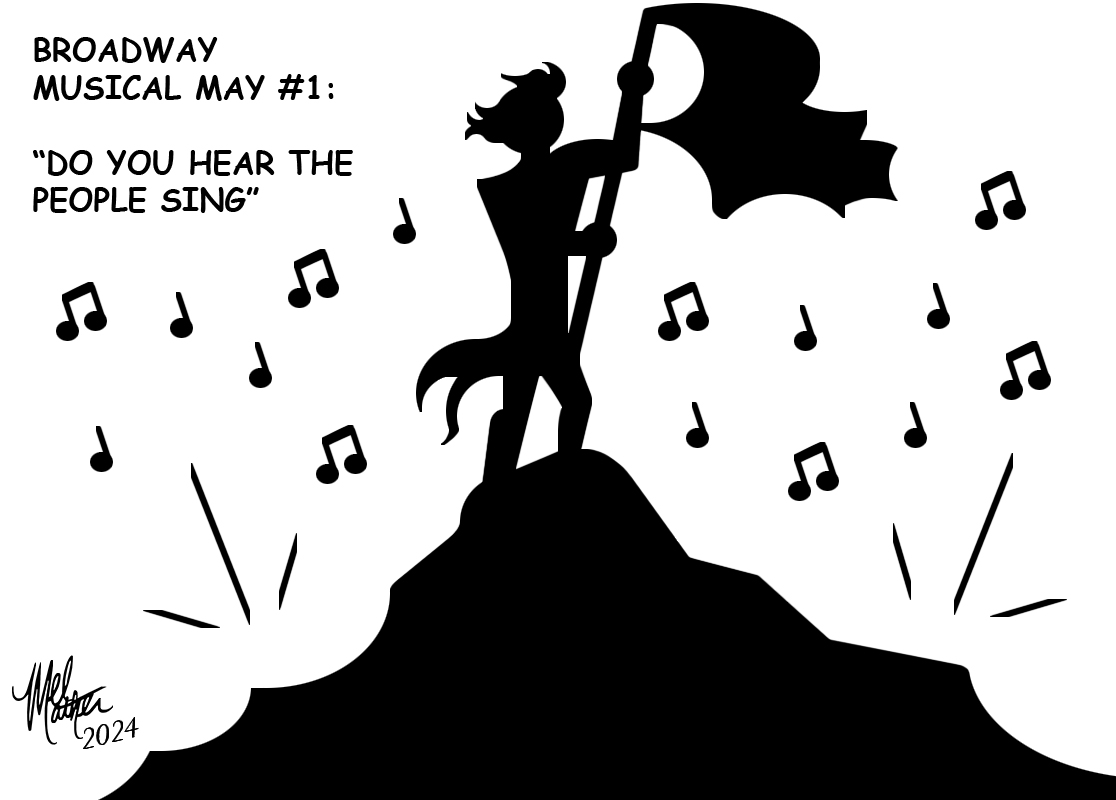
BMM 1 - Do You Hear the People Sing

 
Do you hear the people sing,
Singing the song of angry men?
It is the music of the people
Who will not be slaves again!
When the beating of your heart
Echoes the beating of the drums,

There is a life about to start

When tomorrow comes!
 
Will you join in our crusade?
Who will be strong and stand with me?
Beyond the barricade
Is there a world you long to see?
Then join in the fight

That will give you the right to be free!
 
Do you hear the people sing,
Singing the song of angry men?

It is the music of the people
Who will not be slaves again!
When the beating of your heart

Echoes the beating of the drums,

There is a life about to start

When tomorrow comes!
 
Will you give all you can give
So that our banner may advance?
Some will fall and some will live
Will you stand up and take your chance?

The blood of the martyrs
Will water the meadows of France!
 
Do you hear the people sing,
Singing the song of angry men?

It is the music of the people

Who will not be slaves again!

When the beating of your heart

Echoes the beating of the drums,

There is a life about to start

When tomorrow comes!
 
 
From Wikipedia: "Do You Hear the People Sing?" (French: À la volonté du peuple, literally To the will of the people, in the original French version) is one of the principal and most recognizable songs from the 1980 musical Les Misérables. It is sung twice in the opening and closing section of the stage musical.
 
The song, composed by Claude-Michel Schönberg (music), Alain Boublil and Jean-Marc Natel (original French lyrics), and Herbert Kretzmer (English lyrics) is first sung in Act I by Enjolras and the other students at the ABC Cafe as they prepare themselves to launch a rebellion in the streets of Paris during the funeral procession of General Jean Maximilien Lamarque. The song is sung again in the finale as the concluding song of the musical. This second version, which immediately follows a number by Jean Valjean and others, is sung by the entire cast with revised lyrics, and becomes progressively louder and thunderous with each stanza.
 
The song is a revolutionary call for people to overcome adversity. The "barricades" referred to in the song are erected by the rebel students in the streets of Paris in the musical's second act. They are to draw the National Guard into combat and ignite a civilian uprising to overthrow the government, but their rebellion eventually fails. But in the finale this song transitions into a hymn when all anticipate a world full of peace, freedom, and liberation for all mankind.
 

My own thoughts: I never had a lot of patience for long movies, let alone musicals. Anything that lasts more than two hours makes me fidgety. 
 
That said, Les Misérables was a huge exception. When the 2012 movie came out, it held my interest from beginning to end, and it was this song in particular that convinced me to give Les Mis a try. I fell in love with the version sung by Michael Maguire, but the 2012 film version was done quite well, too. 
 

Snowbird 2026

Snowbird again  Got to go swimming this time.